



What Is “Gastronomy”?
Often translated into Japanese as “fine dining” – but what exactly is it?
Gastronomy… in Japanese it's often translated as “fine dining,” but what on earth is it?
Even we, Gastronomie Partners, are often met with puzzlement on the phone – “Gastr…? Could you say that again?!” (sometimes we even stumble over our own company name…).
Rather unfamiliar to the Japanese ear, the word originally derives from the ancient Greek gastros (digestive organs) + nomos (order, law), and means the cultural and scientific contemplation of food.
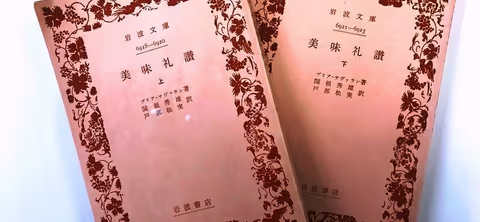
What made the word “gastronomy” widely known to the world was, above all, the 19th-century French author Brillat-Savarin's The Physiology of Taste. Brillat-Savarin, who left us the famous line “Tell me what you eat, and I will tell you what you are,” also left these words:
“Animals feed; man eats; only the man of intellect knows how to eat.”
“The discovery of a new dish does more for the happiness of mankind than the discovery of a star.”
What lavish praise…! More than the discovery of a star…!!
Savarin explains that the beginning of “eating” – that is, the first step of food culture – came not from humans putting what they took from nature straight into their mouths, but from cooking and sharing their catch and gathering family and kin to dine together. Later, as human society formed and expanded and long-distance travel became possible, places of hospitality for weary travelers were set up here and there.
Through daily meals, of course, but also through welcoming travelers from afar and sharing a table, warm exchange is born, and the heart and cultivation to know others and other cultures are nurtured. “Eating” is not merely to stave off hunger; it deepens human bonds and fosters mutual understanding and exchange – in other words, it is the foundation of culture.
In The Physiology of Taste, gourmandise is defined as “the passionate, rational and habitual love of whatever flatters the palate.” “Fine dining” may carry a somewhat highbrow image, but in truth it is nothing other than a “passion for taste,” a “love of sharing a table with others,” and a “respect for the people who create and sustain that table.”
And Gault et Millau is a partner to those who pursue such “fine dining.”
(Next time, for sure, I'll say “Gastronomie Partners” without stumbling…!)
